

Identification of a Compound and Its Active Enantiomer Selectively Targeting Mesothelioma Cells―Toward the Development of Novel Therapeutic Agents Targeting BAP1-Mutant Cancer Cells―
A research group led by Professor Yuko Murakami-Tonami, together with Laboratory Instructor Koya Suzuki and doctoral student Mengshi Qiu at Laboratory of Cancer Molecular Genetics, Tokyo University of Technology Graduate School of Bionics, Computer and Media Sciences, in collaboration with Professor Ichiro Hayakawa at Graduate School of Integrated Basic Sciences, Nihon University, and Designated Associate Professor Ayato Sato at the Institute of Transformative Bio-Molecules (WPI-ITbM), Nagoya University, has identified a small-molecule compound that selectively inhibits the growth of cancer cells harboring mutations in BAP1, one of the major tumor suppressor genes implicated in mesothelioma. The researchers further identified the enantiomer primarily responsible for this activity.
The findings were published online in Bioorganic & Medicinal Chemistry on August 26, 2026.
Background
Mesothelioma is a difficult-to-treat cancer primarily associated with exposure to asbestos. Most of the genes frequently altered in mesothelioma are tumor suppressor genes, and exploiting vulnerabilities associated with these genetic alterations represents a promising strategy for selectively targeting cancer cells.
The research group focuses on synthetic lethality, a therapeutic strategy that exploits vulnerabilities arising from cancer-specific genetic alterations. In particular, the group has been investigating novel therapeutic approaches that take advantage of the loss of function of BAP1, one of the major tumor suppressor genes implicated in malignant mesothelioma.
In this study, the researchers screened a chemical compound library to identify small molecules that selectively inhibit the growth of BAP1-mutant mesothelioma cells. They then investigated the compound Z250-1659 to determine which of its enantiomers is primarily responsible for its selective activity.
Research Findings
Screening of a chemical compound library maintained by Nagoya University’s ITbM identified Z250-1659, initially tested as a racemic mixture, as a small molecule that selectively inhibits the growth of BAP1-mutant malignant mesothelioma cells.
Z250-1659 exists as two enantiomers, the S- and R-enantiomers, whose three-dimensional structures are mirror images of each other. Although enantiomers have very similar chemical properties, they can exhibit different biological activities.
The researchers therefore synthesized the S- and R-enantiomers separately and compared their effects on BAP1-mutant mesothelioma cells. (S)-Z250-1659 showed strong growth-inhibitory activity against BAP1-mutant cells, whereas (R)-Z250-1659 exhibited substantially weaker activity. Furthermore, re-expression of BAP1 reduced cellular sensitivity to the S-enantiomer, indicating that its activity is associated with BAP1 status.
Together, these results demonstrate that the selective growth-inhibitory activity of Z250-1659 against BAP1-mutant mesothelioma cells is primarily attributable to its S-enantiomer.
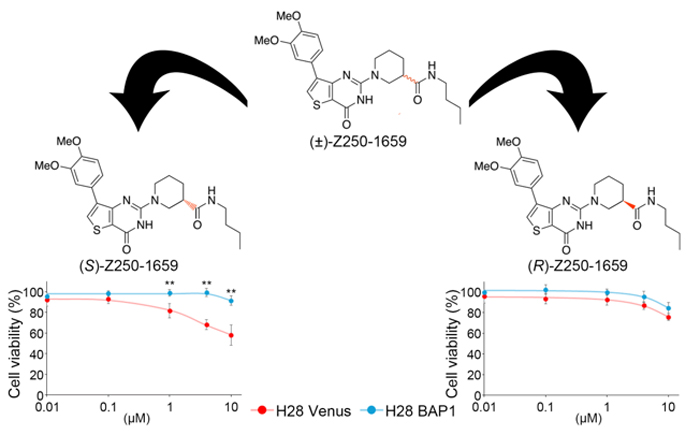
Figure 1. Activity of the S- and R-Enantiomers of Z250-1659 against BAP1-Mutant Mesothelioma Cells
The S- and R-enantiomers of Z250-1659 were synthesized separately and their biological activities were compared. The results demonstrated that the S-enantiomer is primarily responsible for the selective growth-inhibitory activity against BAP1-mutant mesothelioma cells.
Significance and Future Perspectives
This study identifies the enantiomer primarily responsible for the selective activity of a small-molecule compound against BAP1-mutant mesothelioma cells. Compounds that exploit specific genetic alterations in cancer cells may contribute to the development of novel anticancer therapies with reduced effects on normal cells.
Future studies will focus on elucidating the detailed molecular mechanisms and molecular targets through which the compound inhibits the growth of BAP1-mutant cells, as well as on developing more effective compounds based on these findings.
Glossary
BAP1 (BRCA1-associated protein 1)
BAP1 is a tumor suppressor gene involved in various cellular functions, including DNA repair and cell proliferation. Loss-of-function mutations in BAP1 are frequently observed in mesothelioma.
Synthetic lethality
Synthetic lethality is a phenomenon in which the combined disruption of two or more genes or molecular functions results in cell death, whereas disruption of either one alone is not lethal. It has attracted considerable attention as a therapeutic strategy for selectively targeting cancer cells by exploiting cancer-specific genetic alterations.
Enantiomers
Enantiomers are molecules composed of the same atoms with the same chemical connectivity but whose three-dimensional structures are mirror images of each other. Enantiomers, such as S- and R-enantiomers, can exhibit different biological activities. A 1:1 mixture of two enantiomers is referred to as a racemic mixture.
Publication Information
Journal: Bioorganic & Medicinal Chemistry
Title: Synthesis and biological evaluation of optically active Z250–1659 as a synthetic lethal agent against BAP1-deficient mesothelioma cells
Authors: Tomohiro Tsutsumi, Airi Wada, Hikari Yamamoto, Momoko Sato, Sana Tsukioka, Mengshi Qiu, Koya Suzuki, Ayato Sato, Yuko Murakami-Tonami, Ichiro Hayakawa
Publication date: August 26, 2026
DOI: 10.1016/j.bmc.2026.118782
Full-text article: Available free of charge until October 16, 2026.
Laboratory of Cancer Molecular Genetics, School of Bioscience and Biotechnology, Tokyo University of Technology
The laboratory investigates the molecular relationships between genetic alterations and cellular functions in cancer, with the goal of developing novel therapeutic strategies. In particular, the group focuses on synthetic lethality to identify and exploit cancer-specific vulnerabilities.
Its research spans a broad range of approaches, from applied research using small-molecule compounds and nucleic acid therapeutics (siRNA) to fundamental studies using fission yeast as a model organism.
Major Research Areas
1.Elucidation of cell proliferation mechanisms based on synthetic lethal interactions with driver gene mutations in malignant mesothelioma.
2.Development of anticancer approaches using small-molecule compounds and siRNA delivery technologies based on synthetic lethality.
3.Elucidation of the molecular mechanisms of DNA replication, DNA repair, and cell-cycle regulation, including studies using fission yeast models.
Laboratory website:
https://murakami-lab.bs.teu.ac.jp/